The Sun Joe SPX3001 Electric Pressure Washer combines residential cleaning power with an integrated high-pressure hose reel. It is designed for suitable vehicles, decks, patios, siding, driveways, outdoor equipment, and other household surfaces. This guide covers assembly, startup, nozzle and detergent use, hose-reel operation, maintenance, storage, and customer-safe troubleshooting.
Meet the SPX3001
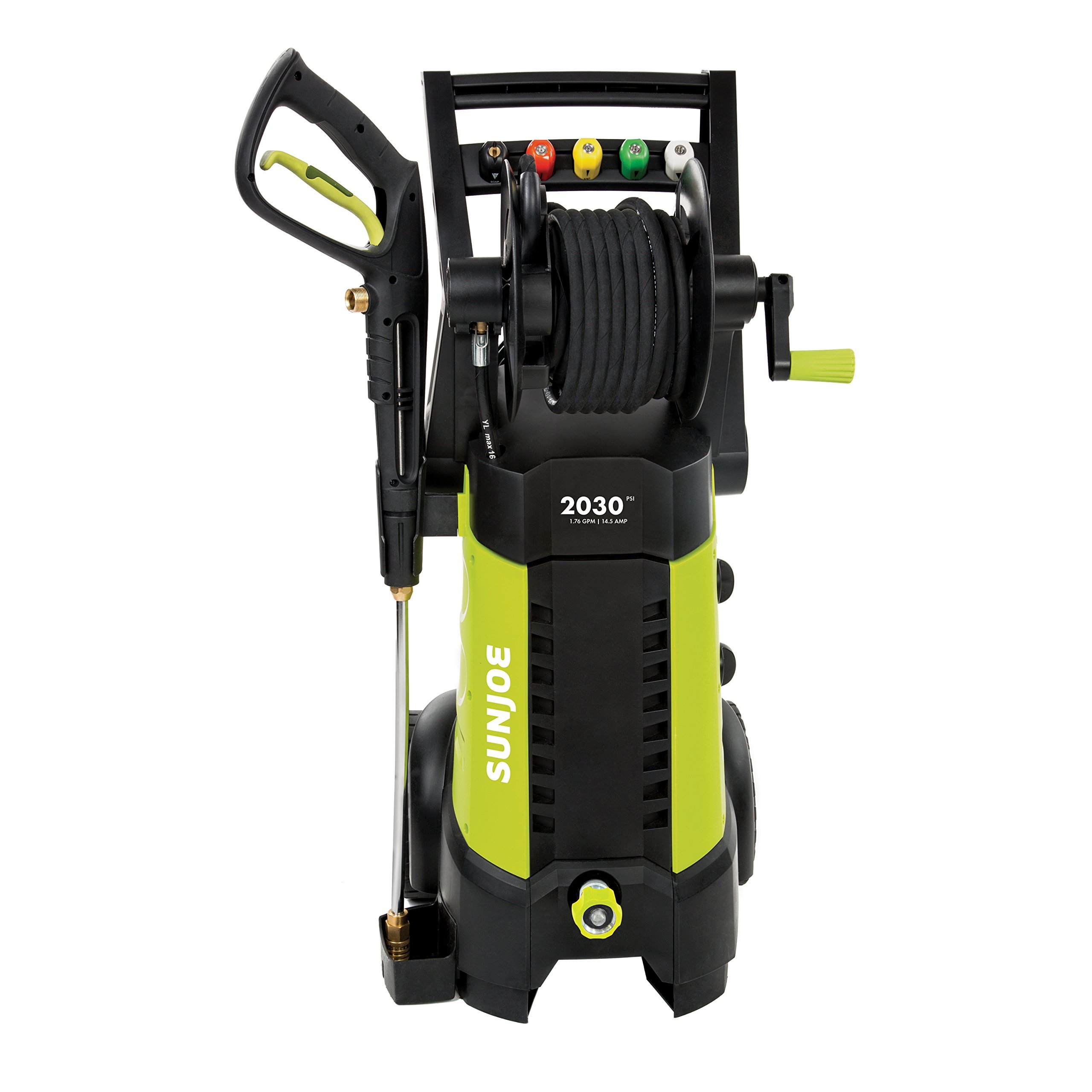


Why It Stands Out
Integrated Hose Reel
The hand-crank reel stores the 20-foot high-pressure hose directly on the unit.
Five Spray Options
Quick-connect 0°, 15°, 25°, 40°, and Soap nozzles cover concentrated, general, gentle, and detergent applications.
Onboard Detergent Tank
The removable 1.2-liter tank and detergent dial support adjustable low-pressure soap application.
Total Stop System
The motor stops when the trigger is released and restarts when the trigger is squeezed.
Technical Specifications
| Model | SPX3001 |
|---|---|
| Rated voltage | 120 V AC, 60 Hz |
| Motor | 14.5 amp |
| Maximum pressure | 2030 PSI at initial discharge under CSA internal pressure testing |
| Rated pressure | 1450 PSI under typical load |
| Maximum flow | 1.76 GPM with nozzle open at minimum pressure |
| Rated flow | 1.24 GPM under typical load |
| Maximum inlet temperature | 104°F (40°C) |
| Maximum inlet pressure | 0.7 MPa |
| Detergent tank | 40.6 fl oz (1.2 L), removable |
| High-pressure hose | 20 ft (6 m) with integrated reel |
| Power cord | 35 ft (10.7 m) with GFCI protection |
| Nozzles | 0°, 15°, 25°, 40°, and Soap quick-connect tips |
| Net weight | 29.8 lb (13.5 kg) |
| Manual | SPX3001 Operator’s Manual |
| Warranty shown in manual | 2 years for residential household use, subject to the warranty terms |
What’s in the Box
- SPX3001 pressure washer with integrated hose reel, 20-foot high-pressure hose, 35-foot GFCI power cord, detergent tank, and wheels
- Trigger gun and spray wand
- 0°, 15°, 25°, 40°, and Soap quick-connect nozzles
- Two small screws
- Spray-wand protector and trigger-gun holder
- Needle clean-out tool
- Garden-hose adapter with female coupler
- Operator’s manual with registration card
Assembly
Before assembly: Keep the washer unplugged and upright on a secure, stable surface close to the water supply.
- Install the trigger-gun holder. Slide it into position and secure it with one supplied screw.
- Install the spray-wand protector. Snap its tabs into the lower-left mounting slots and secure it with the remaining screw.
- Connect the spray wand. Fit it into the trigger gun and rotate until the two parts lock completely.
- Connect the high-pressure hose. Secure the hose from the reel to the trigger gun. Inspect the hose and never use or attempt to repair a damaged one.
- Connect the garden hose. Install the garden-hose adapter on the water inlet, then attach a reinforced garden hose with an internal diameter of at least 1/2 inch.
Water supply: Use clean cold or lukewarm water only. The inlet temperature must not exceed 104°F (40°C), and the inlet pressure must not exceed 0.7 MPa.
Getting Started and Operation
- Check all connections. Confirm the high-pressure hose and garden hose are secure, undamaged, and free of kinks.
- Confirm the switch is off. Verify the outlet voltage and frequency match the rating plate, then plug the washer into the outlet.
- Reset the GFCI. Press Reset until the power indicator illuminates. Do not use the washer if the GFCI does not operate correctly.
- Open the water supply. Turn the faucet completely on.
- Prime the system. Release the trigger lock and squeeze the trigger until water flows steadily and trapped air is removed.
- Install a nozzle. With the washer off and depressurized, engage the trigger lock and insert the selected nozzle into the quick-connect collar until it clicks.
- Start cleaning. Hold the gun firmly with both hands, turn the switch on, and squeeze the trigger. Begin at a safe distance and test an inconspicuous area.
- Pause safely. For a break of five minutes or longer, engage the trigger lock, turn the washer off, and unplug it.
Total Stop System: The motor shutting off when the trigger is released is normal. It restarts when the trigger is squeezed.
Electrical and spray safety: Keep connections dry and off the ground. Never touch the plug with wet hands, operate in rain, or direct the spray at people, pets, electrical equipment, clothing, footwear, flammable liquids, or the washer itself.
Extension-Cord Guidance
Extension cords are not recommended. If one must be used, the manual limits it to 25 feet and requires a 14 AWG or heavier outdoor-rated cord with a watertight connection. The combined cord length must not exceed 60 feet.
Nozzle Guide
| 0° orange tip | Concentrated jet for stubborn deposits and hard-to-reach areas on suitable durable surfaces. Use with extreme care. |
|---|---|
| 15° yellow tip | Intense fan spray for tough cleaning on hard surfaces that can withstand high pressure. |
| 25° green tip | General cleaning for suitable siding, brick patios, wood decks, driveways, and sidewalks. Test a small area first. |
| 40° gray tip | Wider, gentler spray for suitable vehicles, boats, patio furniture, and lawn equipment. |
| Soap black tip | Low-pressure detergent application. Detergent will not dispense through the other nozzles. |
Before changing a nozzle: Turn off and unplug the washer, shut off the water, squeeze the trigger to release pressure, and engage the trigger lock.
Using Detergent
- Use only detergent formulated for pressure washers and prepare it according to its label. Test it on an inconspicuous area first.
- Remove the detergent-tank cap and suction tube, pull out the tank, add detergent, then reinstall the tube, cap, and tank.
- Install the black Soap nozzle and use the detergent dial to adjust the suction volume.
- Apply detergent from the bottom upward on a dry surface. Work in small sections and do not allow detergent to dry.
- After use, place the detergent suction tube in 1.3 gallons (5 L) of fresh water and siphon at low pressure for one minute. Rinse the tank thoroughly.
- Install a suitable rinse nozzle and rinse from the top downward.
Do not use household detergents, bleach or chlorine products, acids, alkaline solutions, solvents, gasoline, oils, ammonia, trisodium phosphate, flammable materials, or industrial-grade solutions.
Shutting Down
- Turn the switch off and unplug the power cord.
- Turn off the water supply.
- Hold the trigger until all remaining pressure is released.
- Disconnect the garden hose and high-pressure hose.
- Release the trigger and engage the trigger safety lock.
Using the Hose Reel
- Shut down and depressurize the washer, then disconnect the high-pressure hose from the trigger gun.
- Pull the hose-reel handle outward to unlock it.
- Turn the handle counterclockwise to wind the hose neatly without kinks.
- Continue until the hose is fully stored, then push the handle inward to lock the reel.
Maintenance, Care, and Storage
- Switch off, unplug, shut off the water, and release pressure before inspection, cleaning, or maintenance.
- Remove the pre-filter and water-inlet filter and rinse them with warm water.
- Remove a clogged nozzle, clear its opening with the supplied needle tool, then back-flush clean water through the nozzle and spray wand.
- Inspect the power cord, GFCI, hoses, gun, wand, safety devices, and connections before use. Replace damaged high-pressure hoses; never repair them.
- Drain all water from the pump, hoses, and detergent tank before storage. Wind the high-pressure hose without kinks and lock the reel.
- Store the washer indoors in a dry, covered, frost-free location above 32°F (0°C). Freeze damage is not covered by the warranty.
- For winter storage, use a noncorrosive, nontoxic pressure-washer pump protector or antifreeze as directed, then flush completely with clear water before reuse.
Troubleshooting
Machine Refuses to Start
Possible Causes
- No power at the outlet or the washer is not fully plugged in.
- The outlet is defective or the GFCI needs to be reset.
- The circuit fuse has blown.
- An extension cord is defective or unsuitable.
Solutions
- Confirm the plug is fully inserted into a working outlet.
- Inspect the cord, reset the GFCI, and try another suitable outlet.
- Switch off other equipment using the same circuit.
- Try the washer without an extension cord.
Pressure Fluctuates
Possible Causes
- The pump is drawing air or a hose connection is not airtight.
- An internal valve or pump seal may need service.
Solutions
- Check all hoses and connections, then hold the trigger until pressure becomes steady.
- If fluctuation continues, stop using the washer and request service review; do not open the pump.
Machine Stops During Use
Possible Causes
- The circuit fuse has blown or the supply voltage is incorrect.
- The thermal sensor has activated.
- The nozzle is partly blocked.
Solutions
- Switch off other equipment on the same circuit and confirm the voltage matches the rating plate.
- Allow the washer to cool for five minutes.
- Clean the nozzle before restarting.
Machine Pulsates
Possible Causes
- Air is trapped in the inlet hose.
- The water supply is inadequate.
- The nozzle or inlet filter is partly blocked.
- The garden hose is kinked.
Solutions
- Hold the trigger until steady pressure returns.
- Open the faucet fully and use a reinforced hose at least 1/2 inch in internal diameter.
- Clean the nozzle and inlet filter.
- Straighten the hose and remove restrictions.
Machine Starts and Stops by Itself
Possible Causes
- The pump, spray gun, hose, or a connection is leaking.
- The trigger mechanism may be damaged.
Solution
Inspect external connections for leaks. If the washer continues cycling, stop using it and request service review.
Machine Runs but No Water Comes Out
Possible Causes
- The pump, hose, or accessories are frozen.
- The water supply is not connected or open.
- The inlet filter or nozzle is blocked.
Solutions
- Allow frozen parts to thaw completely before use.
- Connect and fully open the clean-water supply.
- Clean the inlet filter and nozzle.
Video Guide
Frequently Asked Questions
Why does the motor stop when I release the trigger?
This is normal Total Stop System operation. The motor stops when water flow stops and restarts when the trigger is squeezed.
Which spray nozzles are included?
The washer includes 0°, 15°, 25°, 40°, and Soap quick-connect nozzles.
Can I connect the washer to hot water?
No. Use clean cold or lukewarm water only. The inlet temperature must not exceed 104°F (40°C).
Can I use an extension cord?
Extension cords are not recommended. If one is unavoidable, use a maximum 25-foot, 14 AWG or heavier outdoor-rated cord with watertight connections. The combined cord length must not exceed 60 feet.
What detergent can I use?
Use only detergent specifically formulated for pressure washers. Do not use household cleaners, bleach, acids, alkaline solutions, solvents, flammable liquids, or industrial cleaning products.
Which direction should I turn the hose-reel handle?
Pull the handle outward to unlock it, then turn it counterclockwise to wind the hose. Push the handle inward after winding to lock the reel.
How should I store the washer?
Drain the pump, hoses, and detergent tank, wind the hose without kinks, lock the reel, and store the washer indoors in a dry location above 32°F (0°C).