The Sun Joe SWJ800E-GO Electric Telescoping Pole Chain Saw combines a 6.5-amp motor, an 8-inch low-kickback bar and chain, and a telescoping shaft for pruning branches from the ground. Use this guide for assembly, operation, maintenance, storage, and customer-safe troubleshooting.
Meet the SWJ800E-GO
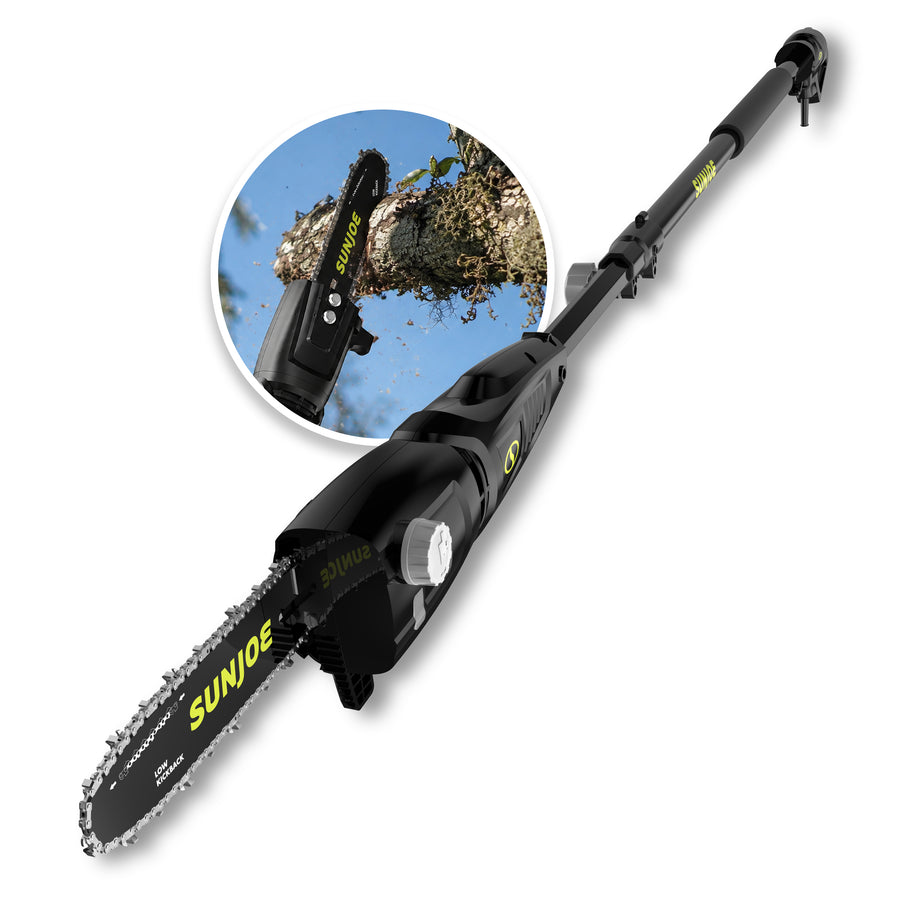
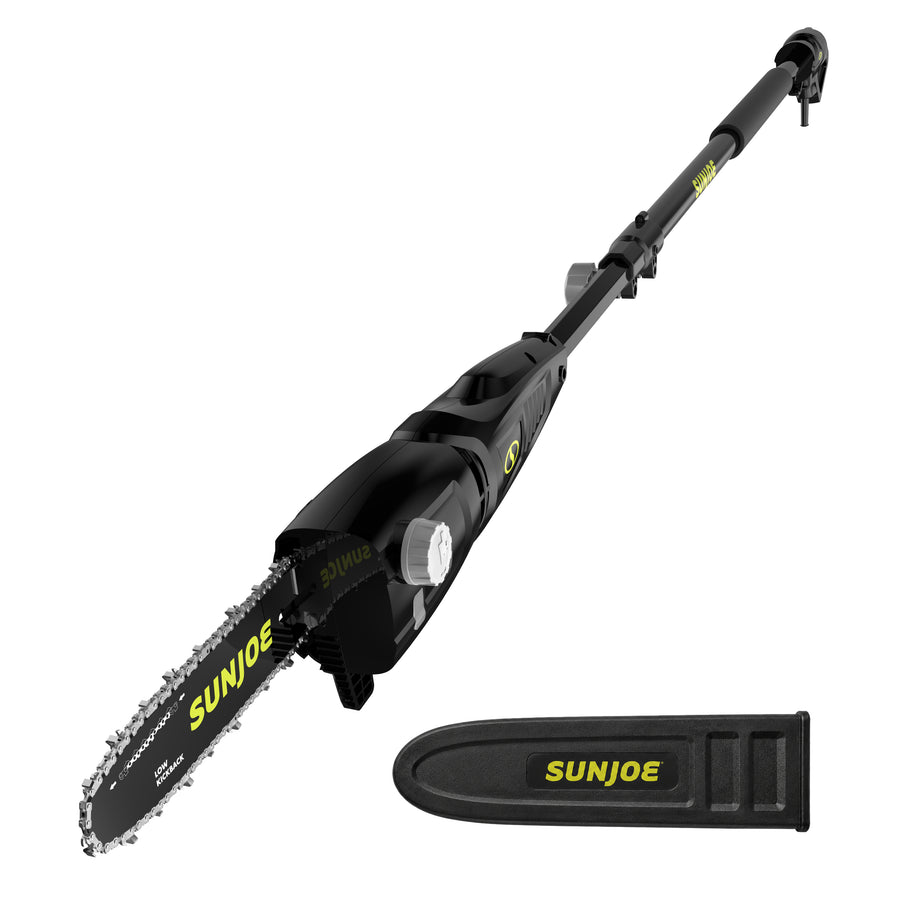


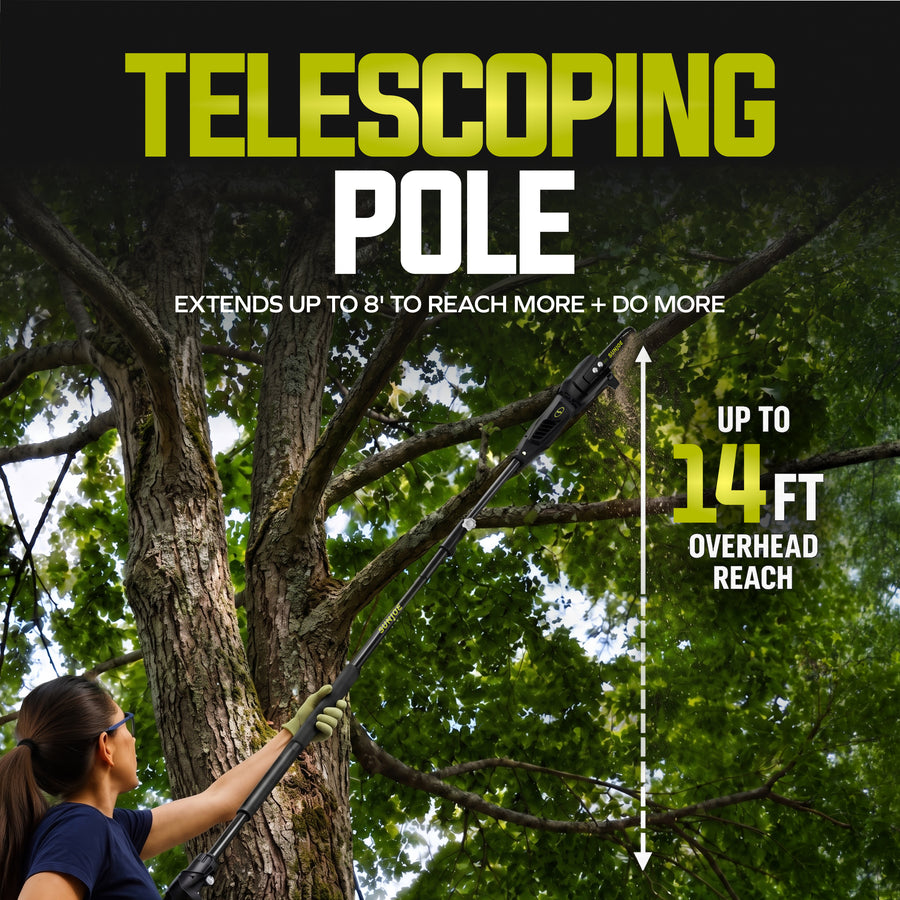
Why It Stands Out
Extended Reach
The shaft adjusts from 5.7 to 8 feet for up to 14 feet of overhead reach.
Controlled Cutting
The 8-inch low-kickback bar and skip chain cut limbs up to 7 inches thick.
Automatic Oiling
The 3.4-fluid-ounce reservoir continuously lubricates the bar and chain during operation.
Lightweight Handling
At 6.6 pounds, the pole saw is designed for easier maneuvering while working from the ground.
Technical Specifications
| Model | SWJ800E-GO |
|---|---|
| Rated voltage | 120 V AC, 60 Hz |
| Motor | 6.5 amp |
| Bar and chain length | 8 in. (20.3 cm) |
| Telescoping shaft | 5.7 ft to 8 ft (1.73 m to 2.43 m) |
| Maximum overhead reach | 14 ft (4.3 m) |
| Maximum cutting thickness | 7 in. (18 cm) |
| Recommended cutting thickness | 5.7 in. (14.5 cm) |
| Oil-tank capacity | 3.4 fl oz (100 ml) |
| Chain specifications | 33 drive links; 3/8-in. pitch; 0.050-in. gauge; 5/32-in. file diameter |
| Product dimensions | 94.5 in. L x 4.1 in. W x 5.1 in. H |
| Net weight | 6.6 lb (3 kg) |
| Manual | Search SWJ800E-GO on the Product Manuals page |
| Warranty | 2 years |
What’s in the Box
- Chain-saw main handle
- Chain-saw motor head
- 8-inch chain
- 8-inch guide bar
- Multifunction tool
- Bar cover
- Operator’s manual
Assembly
Before assembly: Unplug the saw and wear heavy-duty gloves. Assemble it on a flat, stable surface. Never start the motor until the guide bar, chain, and side cover are installed correctly.
- Install the chain on the guide bar. Place the chain in a loop with the sharp edges facing in the rotation direction shown on the bar. Starting at the tip, fit the drive links into the bar groove and leave a loop at the rear.
- Mount the bar and chain. Place the chain around the drive sprocket, lower the bar onto the two fixing bolts, and make sure the adjusting pin enters the bar’s tension-pin hole.
- Refit the side cover. Align the cover openings and slightly tighten both retaining nuts. Do not fully tighten them yet.
- Set the chain tension. Turn the chain-tensioner screw until the chain has no sag underneath the bar, remains snug, and can rotate without binding. A cold chain should lift approximately 2 to 4 mm from the guide bar.
- Secure the bar. Lift the bar tip and fully tighten both retaining nuts. Recheck that the chain rotates without binding.
- Connect the extension bar. Loosen the locking knob, extend the bar about 6 inches, and retighten the knob. Align the extension bar with the motor-head groove and mounting holes.
- Secure the motor head. Insert the supplied screw through the aligned holes, attach the nut, and tighten with the stored hex key. Confirm the four preassembled motor-head nuts and bolts are also tight.
New-chain reminder: A new chain stretches during early use. Check its tension frequently and adjust it only while the saw is unplugged and the chain is cool.
Getting Started and Operation
- Inspect the saw. Check the chain, guide bar, housing, fasteners, oil port, air vents, chain tension, and cutting teeth. Do not use damaged parts.
- Add bar and chain oil. Stand the saw vertically on its resting foot and fill the reservoir to the top of the oil-level window. Refill when the level reaches the minimum mark.
- Set the pole length. While unplugged, loosen the locking knob, extend only as far as needed, then tighten the knob securely.
- Connect outdoor power. Use a heavy-duty, outdoor-rated extension cord connected to a GFCI-protected 120V outlet. Loop the extension cord through the handle opening and around the cord-restraint hook.
- Take a safe stance. Stand on solid ground outside the path of falling debris. Hold the rear handle with one hand and the foam-covered pole with the other. Keep the saw at an angle of 60 degrees or less.
- Start the saw. Make sure the chain touches nothing. Push the safety switch forward with your thumb, squeeze the On/Off trigger fully, and allow the chain to reach full speed before entering the cut.
- Make the cut. Keep the chain running throughout the cut and apply only light downward pressure. Let the chain do the work; do not force it.
- Stop safely. Release the trigger and safety switch. Wait for the chain to stop completely before lowering or moving the saw. Wait at least five seconds before restarting.
Electrocution hazard: Keep the pole saw at least 50 feet (15 m) from overhead wires. Do not operate in rain, wet conditions, or lightning. Never work from a ladder, tree, scaffold, or unstable support.
Protective equipment: Wear safety glasses, hearing protection, head protection, heavy-duty gloves, non-slip footwear, close-fitting clothing, and a dust mask when the work creates dust. Keep all people and pets away from the cutting area.
Extension-Cord Requirements
| Cord Length | Minimum Wire Gauge |
|---|---|
| Up to 50 ft (15 m) | 16 AWG |
| More than 50 ft to 100 ft (15 m to 30 m) | 14 AWG |
Use only a polarized UL-, CSA-, or ETL-rated extension cord marked for outdoor, all-weather use. Do not use a cord longer than 100 feet. Keep the cord away from the chain, heat, oil, sharp edges, and standing water.
Pruning Procedure
- Remove long branches in several stages and cut lower branches first to create room for upper branches to fall.
- For a large live branch, make the first cut from underneath to about one-third of its diameter.
- Make the second cut from above, farther out on the branch, to remove its weight.
- Finish with a clean top cut near the main limb or trunk so the bark can grow back and seal the wound.
If the bar becomes pinched: Release the trigger, wait for the chain to stop, allow the saw to cool for five minutes, unplug it, and put on gloves. If the limb cannot be lifted safely from the ground to release the saw, contact a professional.
Maintenance, Care, and Storage
- Unplug the saw and allow it to cool for at least five minutes before adjustment, cleaning, maintenance, transport, or storage.
- Check cold-chain tension before every use. The chain should be snug with no sag underneath the bar but able to rotate without binding.
- Keep the motor air vents, guide-bar groove, lubrication holes, and oil port free of sawdust and debris.
- Keep all nuts, screws, retaining nuts, and the telescoping-pole locking knob secure.
- Use only fresh bar and chain oil formulated for chain saws. Empty the oil tank after each use to reduce seepage.
- Replace a chain that no longer cuts cleanly and safely. Chain sharpening requires skill and specialized tools; professional sharpening is recommended.
- Clean the housing with mild soap and a damp cloth. Never immerse the housing or allow liquid inside the motor.
- Install the bar cover and store the unplugged saw indoors in a dry, high, or locked location away from children, fertilizers, solvents, gasoline, and petroleum-based products.
Troubleshooting
The Saw Motor Does Not Start
Possible Causes
- The extension cord is not fully connected or the outlet has no power.
- The safety switch is not being held before the trigger is squeezed.
- The chain is too tight.
Solutions
- Reconnect the outdoor extension cord and confirm the 120V outlet is live.
- Push and hold the safety switch before squeezing the On/Off trigger.
- Unplug the saw and correct the chain tension.
The Saw Runs, but Chain Speed Is Low
Possible Causes
- The chain is too tight.
- The oil tank is empty.
- The lubrication holes are blocked.
Solutions
- Unplug the saw and correct the chain tension.
- Refill with fresh bar and chain oil.
- Clean the lubrication holes and guide-bar groove.
The Bar and Chain Are Hot or Smoking
Possible Causes
- The chain is too tight.
- The guide bar or chain is damaged.
Solutions
- Stop immediately, unplug the saw, and allow it to cool.
- Correct the chain tension.
- Inspect the bar and chain and replace any damaged part before use.
The Motor Runs, but the Chain Does Not Turn
Possible Causes
- The chain is too tight.
- The guide bar or chain is damaged.
Solutions
- Unplug the saw and correct the chain tension.
- Inspect the guide bar and chain and replace damaged parts.
Oil Seeps During Storage
Possible Cause
A small amount of oil seepage while the saw is stored is normal.
Solutions
- Empty the oil tank after each use.
- For storage of three months or longer, lightly lubricate the chain to help prevent rust on the chain and bar sprocket.
Cutting Performance Is Poor or the Cut Is Not Straight
Possible Causes
- The chain is dull or worn.
- The chain needs professional sharpening or replacement.
Solutions
- Stop using the saw if sawdust looks like dust, cutting becomes difficult, the cut is not straight, or vibration increases.
- Have the chain sharpened with the correct tools or replace it when the cutting edges are 5 mm or shorter or the links and rivets have excessive play.
Unusual Vibration or Odd Sounds
Solution
Switch the saw off immediately, unplug it, and inspect for damage. If the cause cannot be identified and corrected safely, do not use the saw until it has been inspected by an authorized service provider.
The Motor Overheats
Possible Cause
The cooling air vents are blocked by sawdust or debris.
Solution
Switch off and unplug the saw, allow it to cool, and clean the air vents.
The Chain Comes Off the Guide Bar
Possible Cause
The chain is loose or the retaining nuts were not tightened after adjustment.
Solutions
- Unplug the saw and retension the chain so it is snug but still rotates without binding.
- Fully tighten both retaining nuts and recheck the tension before use.
Frequently Asked Questions
How far does the pole saw reach?
The shaft adjusts from 5.7 to 8 feet and provides up to 14 feet of overhead reach. Actual working reach depends on the operator’s height and position.
What size branches can it cut?
The maximum cutting thickness is 7 inches. The recommended cutting thickness is 5.7 inches.
Does the saw require bar and chain oil?
Yes. Add fresh bar and chain oil before operation and monitor the transparent oil-level window. The automatic oiler cannot protect the bar and chain when the reservoir is empty.
Can I use the pole saw in rain or wet conditions?
No. Do not operate the saw in rain, wet locations, or while standing in water. Use a GFCI-protected outlet and an outdoor-rated extension cord.
Can I use the saw from a ladder?
No. Operate only while standing on solid ground. Never use the pole saw from a ladder, tree, scaffold, or other unstable support.
Why does oil leak from the saw after use?
A small amount of seepage during storage is normal. Empty the oil tank after each use to reduce seepage.